
Electric Underfloor Heating Pros and Cons: A 2026 UK Homeowner’s Guide
If you’re weighing up electric underfloor heating pros and cons, the short version is this. It’s cheap to install, warms a room evenly and takes up no wall space, but it costs more to run than gas central heating or a water based system, and it isn’t always the best choice for heating a whole house. Which option suits you depends on the room, your floor build up and how you plan to use it.
This guide walks through how electric underfloor heating works, where it genuinely pays off, where it falls short, and how it compares with water (wet) underfloor heating systems, which are usually installed within a liquid screed floor.
How electric underfloor heating works
Electric underfloor heating, sometimes called a dry system, uses a thin heating cable or mat installed just beneath the floor covering. It’s wired into the mains and controlled by a thermostat, so each room or zone can be switched on independently. There’s no boiler, no pipework and no manifold involved, which is part of why it’s popular for bathroom and kitchen renovations.
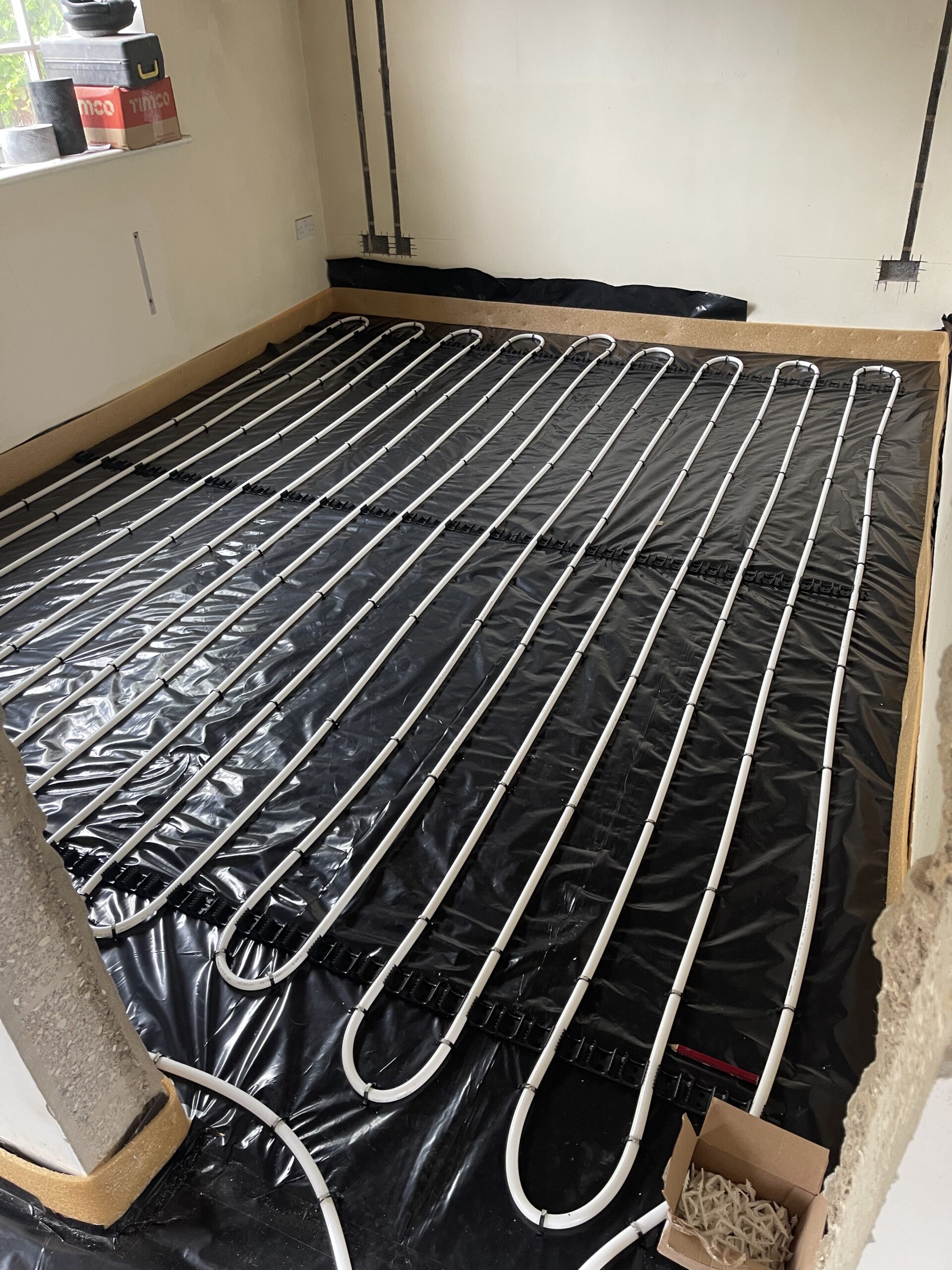
Water (wet) underfloor heating works differently. It circulates warm water through a network of pipes, usually fed by a boiler or heat pump, and those pipes are typically embedded in a liquid screed floor rather than the traditional sand and cement mix. We’ll come back to how that comparison plays out below.
Pros of electric underfloor heating
Lower installation cost
Electric systems are generally cheaper and quicker to fit than wet systems, since there’s no boiler connection, manifold or pipework to install. This makes them a popular choice for single room retrofits, such as a bathroom or kitchen extension, where running new pipework would be disruptive.
Even heat, no cold spots
Because the whole floor acts as the heat source, warmth rises evenly through the room rather than radiating from one wall mounted unit. Which? notes that underfloor heating systems in general can run at relatively low surface temperatures, typically around 35°C, compared with 55 to 65°C for a radiator, while delivering the same level of comfort. Electric systems also heat up slightly faster than water based systems, typically within an hour to 90 minutes.
Slim profile
Electric heating mats and cables can be as thin as 42mm once installed, making them a practical option where floor height is tight, such as in a renovation or loft conversion. A water based system is bulkier, often around 130mm, though this can be reduced with a liquid screed floor build up.
No radiators, more usable wall space
With the heat source hidden under the floor, you get the wall space back for furniture, storage or simply a cleaner looking room, and there’s nothing for children or pets to bump into.
Low maintenance
Once installed, electric underfloor heating has no moving parts, no valves and nothing that needs bleeding. Faults are rare during normal use and are more likely to stem from installation damage than day to day wear.
Works under most floor coverings
Electric systems can go under tile, stone, engineered wood, vinyl and most laminates. Tile and stone conduct heat the most efficiently, while thick carpet and solid wood aren’t recommended because they trap heat or can warp.
Cons of electric underfloor heating
More expensive to run
This is the trade off that catches most homeowners out. Electric underfloor heating is generally more expensive to run than a gas fed wet system, simply because electricity costs more per unit than gas. Under the Ofgem price cap for July to September 2026, the average direct debit rate is 26.11p per kWh for electricity against 7.33p per kWh for gas, a gap of well over three times.
The Energy Saving Trust puts it plainly, dry electric systems are usually cheaper to install but more expensive to run than wet systems. For a single bathroom on a timer, that difference is manageable. As your primary heating for a whole ground floor, it adds up fast.
Not ideal as your only heat source in an older property
To work well as the sole heat source in a room, an electric system needs to cover at least 80 to 90% of the floor area, run at a minimum of 200W per square metre, and sit above proper insulation boards to stop heat escaping downwards. In an older home with solid walls, no loft insulation or single glazed windows, underfloor heating alone often can’t keep up, whichever type you choose.
Repairs can mean lifting the floor
Faults are uncommon, but if a cable does fail, a specialist engineer needs to pinpoint the break, which can mean excavating a section of flooring rather than a simple call out job. It’s worth checking what warranty or guarantee is included before you buy.
Limited scope for whole house heating
Electric underfloor heating is rarely used to heat an entire house, both because of the running cost and because most homes don’t have the spare electrical capacity for it without upgrades. For whole house projects, a water based system fed by a boiler or heat pump is the more common and more cost effective route.
Electric vs water underfloor heating: which is right for you
Neither system is universally better, it depends on the scope of the project.
Electric underfloor heating tends to make sense for smaller, self contained areas such as a bathroom, ensuite or kitchen extension, particularly where a wet system would mean disruptive pipework and where the room already has central heating covering the rest of the house.
Water underfloor heating usually wins out for new builds, extensions and full renovations, especially where the property is being fitted with a heat pump. Because heat pumps run most efficiently at lower flow temperatures, and underfloor heating typically only needs 35 to 45°C to heat a room compared with 60 to 70°C for radiators, the two pair naturally. The Energy Saving Trust notes that pairing a wet underfloor system with a heat pump can be considerably more efficient than running an older boiler through radiators.
This is where liquid screed comes in. Rather than the pipework being set in a thick, slow drying sand and cement mix, it’s poured around the heating pipes in a thinner, self compacting layer with no voids, giving the system exceptional thermal conductivity of up to 2.9W/m.k. It also dries and can be walked on far sooner, and 100 square metres can be laid in under 45 minutes. For anyone installing underfloor heating as part of a new build or major renovation, that combination of speed, efficiency and a slimmer floor build up is usually the better long term investment.
Is electric underfloor heating worth it?
For a single room, particularly somewhere like a bathroom where you want warm tiles underfoot and don’t want to disturb the rest of your heating system, electric underfloor heating is usually worth it. The lower installation cost and simple retrofit make it an easy win.
For heating a whole floor or property, the higher running cost tends to outweigh the lower install price over time, and a water based system, especially one paired with a heat pump and laid in liquid screed, will usually work out cheaper to live with.
FAQs
Is electric underfloor heating cheaper to run than gas central heating?
No, generally not. Because electricity costs more per unit than gas, running electric underfloor heating as your main heat source usually costs more than a gas boiler feeding radiators or a water underfloor system. It can still work out cost effective for a single room that would otherwise need its own separate heating zone.
Can you have electric underfloor heating with liquid screed?
Liquid screed is most commonly used with water underfloor heating, where it’s poured around the pipework itself. Electric mats and cables are usually installed just beneath the floor covering rather than embedded in screed, though a screeded floor can still be used above an electric system in some builds.
How long does electric underfloor heating take to install?
A straightforward mat installation in a single room can often be completed in a day, though the floor and adhesive need time to cure before you can walk on it or lay tiles. This is usually much quicker than a water system, which involves pipework, a manifold connection and, in most cases, a screed floor that needs time to dry.
Is electric underfloor heating worth it in a UK home?
It’s worth it for smaller spaces like bathrooms, ensuites and kitchens, where the lower installation cost and easy retrofit outweigh the running cost. For whole house heating, most UK homeowners are better served by a water based system, particularly if a heat pump is part of the plan.
What is the difference between electric and water underfloor heating?
Electric systems use a heating cable or mat wired into the mains, are cheaper and quicker to install, and suit single rooms. Water systems circulate warm water through pipes fed by a boiler or heat pump, cost more to install but less to run, and are the usual choice for heating a whole property, particularly when laid within a liquid screed floor.