
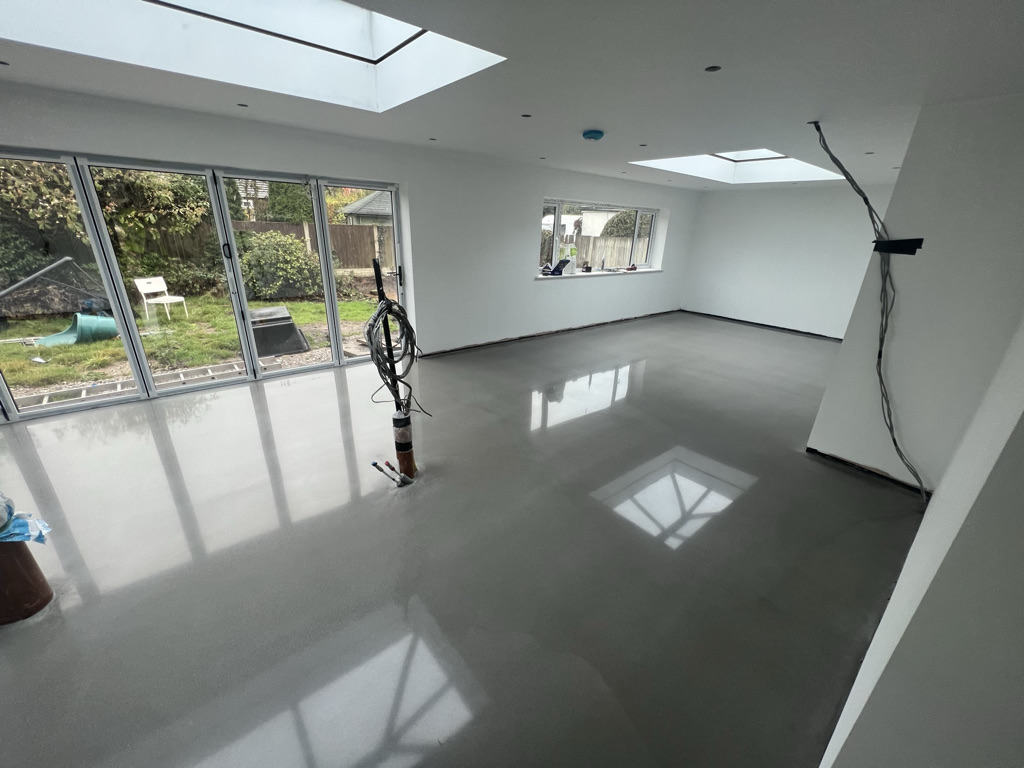
How Long Does Screed Take to Dry? UK Drying Times by Screed Type
How long does screed take to dry? Most screeds can be walked on within 24 to 48 hours, but being dry enough for tiles, wood or vinyl takes far longer. As a rule of thumb, screed dries at about 1mm a day for the first 40mm and half that speed beyond it, in good conditions of 20°C and 65% relative humidity. That puts a typical 50mm anhydrite liquid screed at around two months, a cementitious liquid screed at around two to four weeks, and a 75mm sand and cement screed at well over three months.
Those numbers move a lot depending on the product, the depth and, above all, the conditions on site. This guide breaks drying times down by screed type, explains what speeds drying up or slows it down, and covers the part most people skip: proving the floor is dry before anything goes on top.
Screed Drying Times at a Glance
Here’s how the main screed types used in UK homes and extensions compare under good drying conditions.
| Screed type | Walk on | Typical time until ready for floor coverings* | Force drying |
|---|---|---|---|
| Calcium sulphate (anhydrite) liquid screed, 40 to 50mm | 24 to 48 hours | Around 40 days at 40mm, around 60 days at 50mm | Yes, from 7 days |
| Cementitious liquid screed (e.g. Cemfloor), up to 50mm | 24 hours | Around 15 days at 20°C, 21 days for conventional tile adhesive, 28 days for wood or laminate | Yes, from 7 days |
| Rapid drying cementitious liquid screed (e.g. Longfloor IntegraCure Rap7D), 50mm | Check product guidance | 5 days for non moisture sensitive coverings, 7 days to 75% RH | Not normally needed |
| Traditional sand and cement, 65 to 75mm | 24 to 48 hours | Roughly 90 to 110 days using the BS 8204 rule of thumb | Only once the screed is strong enough |
*Based on manufacturer figures at around 20°C and 65% relative humidity. Always confirm with a moisture test before laying floor coverings.
The 1mm a Day Rule, and Where It Breaks Down
The figure you’ll hear from most screeders comes from the British Standard for screeds. Gyvlon’s post installation guidance describes it as a rough guide from BS 8204: standard traditional and flowing screeds dry at roughly 1mm a day up to 40mm, then about half a millimetre a day after that, in very good conditions of 20°C and 65% RH.
Run the numbers and the depth penalty becomes obvious:
- 40mm screed: about 40 days
- 50mm screed: about 60 days
- 65mm screed: about 90 days
- 75mm screed: about 110 days
The catch is that word “very good”. An unheated extension in a damp British autumn is nowhere near 20°C and 65% RH. Gyvlon notes that cold, humid sites above 70% RH greatly increase the number of days a screed takes to dry, and low indoor temperatures slow it further. So treat the rule as a best case for planning, not a date to book your flooring fitter.
How Long Does Screed Take to Dry by Type?
Calcium Sulphate (Anhydrite) Liquid Screed
Anhydrite screeds such as Gyvlon and Gypsol follow the 1mm a day rule closely. Our own liquid screed aftercare guide puts a typical 40mm screed at around 40 days to reach 0.5% moisture content in ideal conditions. Light foot traffic is usually fine after 24 to 48 hours, and the Flowing Screeds Association confirms that range as standard for flowing screeds.
The big advantage of anhydrite is that it can be force dried. Dehumidifiers can go in from around 72 hours, and underfloor heating can be commissioned from 7 days. Most standard anhydrite screeds also need sanding 3 to 10 days after installation to remove surface laitance, which opens the surface up and helps it dry. If you’d rather not do that yourself, our laitance removal service handles it.
Cementitious Liquid Screed
Cement based liquid screeds tend to dry faster than anhydrite. The Cemfloor technical data sheet gives typical drying times of 15 days for thicknesses up to 50mm at 20°C and 65% RH or less. For specific floor finishes it suggests 21 days before tiling with a conventional adhesive and 28 days for solid wood or laminate, falling to 11 to 13 days when underfloor heating is used to force dry it.
Cementitious screeds also don’t leave a weak surface laitance once cured and can go into permanently wet areas, which is why they’re often chosen for bathrooms and wet rooms.
Rapid Drying Screeds
When the programme is tight, rapid drying mixes change the picture completely. Marshalls’ Longfloor IntegraCure Rap7D data sheet states the screed reaches 75% RH seven days after installation at 50mm thick, with non moisture sensitive coverings possible from five days. On the anhydrite side, Gyvlon’s Advanced range with its E2C additive is described as drying twice as fast as standard screeds. Both still depend on decent site conditions, but they can take weeks off a build.
Traditional Sand and Cement Screed
Sand and cement is the slowest of the lot, mostly because it’s laid thicker. The FSA notes a typical traditional screed over insulation is around 75mm, compared with 40mm for a flowing screed. At 75mm, the rule of thumb points to more than three and a half months of drying. Cement based screeds can also be sensitive to losing moisture too early, so heaters and dehumidifiers shouldn’t go in until the screed has gained enough strength.
What Slows Screed Drying Down
Thickness is the obvious one, but site conditions usually make the bigger difference.
- Cold air. Water evaporates far more slowly in a cold building, so winter pours almost always take longer.
- High humidity. If the air is already damp, it can’t take much more moisture from the screed and drying stalls.
- Poor airflow. Still air sits just above the surface and holds moisture there.
- Covering the floor. Gyvlon warns that stacking plasterboard and materials on a screed for long periods delays drying underneath.
- Extra water. Hosing the floor down, leaks and late wet trades all put moisture back in.
- Gas heaters. Fossil fuel heaters release water vapour and raise humidity, so Gyvlon advises against them.
How to Speed Up Screed Drying Safely
Ventilation does most of the work. Once the first 48 hours of curing are over, open windows and doors during the day so moist air can escape, then close them at night. Both the Gyvlon and Cemfloor guidance recommend this daily routine, with Cemfloor’s starting from 72 hours.
Where windows can’t be opened, dehumidifiers help, as long as the doors are kept shut so they’re not trying to dry the whole street. Avoid blasting the surface with direct hot air. Cemfloor’s data sheet warns that direct heating by hot air or radiant heat can cause curling.
Using Underfloor Heating to Dry Screed
If you’ve got wet underfloor heating in the floor, it’s your best drying tool. The FSA says it can usually be switched on after 7 days, starting at a low temperature and raising it gradually under the screed and heating manufacturers’ guidelines, with the process signed off by a qualified person.
Gyvlon’s commissioning sequence is a good example of what that looks like. Start at around 20°C for 24 hours, raise the manifold temperature by 5°C a day up to the maximum commissioning temperature (up to 45°C), hold it there for 5 days, then bring it back down by 5°C a day. The system is then switched off and left to cool for 48 hours before moisture testing. Cemfloor’s process is similar but allows up to 55°C, held for 4 days.
Commissioning isn’t optional, either. Cemfloor’s data sheet is clear that no floor finish should go onto a heated screed until the system has been fully commissioned and run.
How to Tell When Screed Is Actually Dry
You can’t tell by looking at it. A screed can look pale and feel hard while still holding enough moisture to ruin a wood floor. The only reliable answer is a moisture test, and the FSA says the usual maximum is 75% relative humidity using the British Standard method, though the floor covering manufacturer’s limit always takes priority.
Anhydrite screeds need a little more care. Gyvlon points out that surface hygrometers aren’t accurate on calcium sulphate screeds at higher moisture levels, and recommends a carbide (CM) test or oven drying instead. As a rough conversion, 75% RH is about 0.5% moisture content. Limits also vary by finish. Gyvlon’s standard range allows up to 1.0% for loose laid carpet, 0.5% for bonded vinyl and just 0.4% for bonded engineered wood.
Common Drying Mistakes to Avoid
- Booking the flooring fitter based on the calendar rather than a test result.
- Laying wood or vinyl over a heated screed before the underfloor heating has been commissioned.
- Using a standard cement based tile adhesive on an anhydrite screed that hasn’t reached its moisture target.
- Leaving the laitance on an anhydrite screed, which is too weak to bond to and slows drying.
- Testing straight after running the heating, when the floor hasn’t cooled for 48 hours.
Plan Your Floor Around the Drying Time
The best way to avoid delays is to choose the right screed at the start. If your programme is tight, a cementitious or rapid drying mix may save weeks. If you’re fitting underfloor heating, an anhydrite screed can be force dried with the system itself. Either way, building realistic drying time into the schedule is cheaper than lifting a failed floor.
Express Liquid Screeds installs both calcium sulphate and cementitious liquid screeds as approved installers for the major UK manufacturers. If you’re new to the options, our guide to what liquid screed is is a good place to start. Get in touch and we’ll recommend the mix and drying plan that fits your project.
FAQs
How long after screeding can you walk on it?
Most liquid screeds take light foot traffic after 24 to 48 hours. Keep heavy traffic and stacked materials off it for at least a week, and protect it with boards if trades need to work on it.
How long does 50mm screed take to dry?
In good conditions, a 50mm anhydrite liquid screed takes around 60 days using the 1mm a day rule. A 50mm cementitious liquid screed such as Cemfloor is typically around 15 days, and a rapid drying mix can reach 75% RH in about 7 days. Cold or humid sites will take longer.
Can you tile onto screed after 7 days?
Only with specific products. Cemfloor allows tiling after around 5 to 7 days with its specialised adhesive, and rapid drying screeds are designed to be ready at 7 days. A standard anhydrite screed won’t be dry enough, so wait for a moisture test result.
When can I turn on underfloor heating after screeding?
Usually after 7 days, starting at a low temperature and raising it gradually by around 5°C a day. The commissioning process should follow the screed and heating manufacturers’ guidance and be signed off before any floor covering is laid.
Does screed dry faster in summer?
Generally yes. Drying times are quoted for around 20°C and 65% relative humidity, so warm, dry, well ventilated conditions help a lot. In winter, heating, dehumidifiers or commissioning the underfloor heating can make up some of the difference.